The problem
Someone on Jobseeker’s Allowance in a Dublin City Council home works one 8-hour day at €14.15 an hour. They earn €113.20. Then:
- their welfare payment drops by €56.00,
- their council rent goes up by €10.30,
- and fares and lunch cost €9.00.
That leaves €37.90 for a full day’s work, or about €4.74 an hour. In a school-holiday week with paid childcare, it falls to €17.65. Without the childcare subsidy, they are €16.10 worse off for working.
Nobody pays tax at these earnings. The money goes on welfare cuts and rent increases, which together take 59% of every extra day’s pay. That is a higher rate than any high earner pays.
See the difference
The amount kept each week after welfare changes, extra council rent, €9 a day for fares and lunch, and any childcare cost. Childcare is school-age care at €6/hour with a €3.75/hour National Childcare Scheme subsidy: 4 hours a day in a school week, 9 hours in a holiday week.
How it works
- A €115 weekly allowance. The first €115 a week of earnings is ignored for welfare and council rent. It is linked to 8 hours at the minimum wage, so it rises when the minimum wage does.
- A 40% welfare taper. Above €115, the payment falls by 40c for each euro earned instead of 60c.
- Rent on what you actually gain. Council rent is set on the income left after the welfare reduction, not on gross pay.
- A 50% cap. Welfare cuts and extra rent together never take more than half of any extra euro earned.
- The same rules in every means test. HAP, RAS, Fuel Allowance, the medical card and the childcare scheme all ignore the first €115.
- Childcare for paid hours. Hours worked qualify for the full childcare subsidy, including in school holidays.
- A weekly earnings test. This replaces the rule that you must be unemployed 4 days out of 7, so there is no cliff on the fourth day.
What you keep each week
| Days worked | Current rules | First Day Free |
|---|---|---|
| 1 day | €37.90 | €104.20 |
| 2 days | €75.94 | €152.70 |
| 3 days | €113.91 | €200.30 |
| 4 days | Jobseeker’s Allowance stops | Payment keeps tapering |
Each extra day after the first is worth about €48 a week under the plan, so working more always pays.
The plan on one page
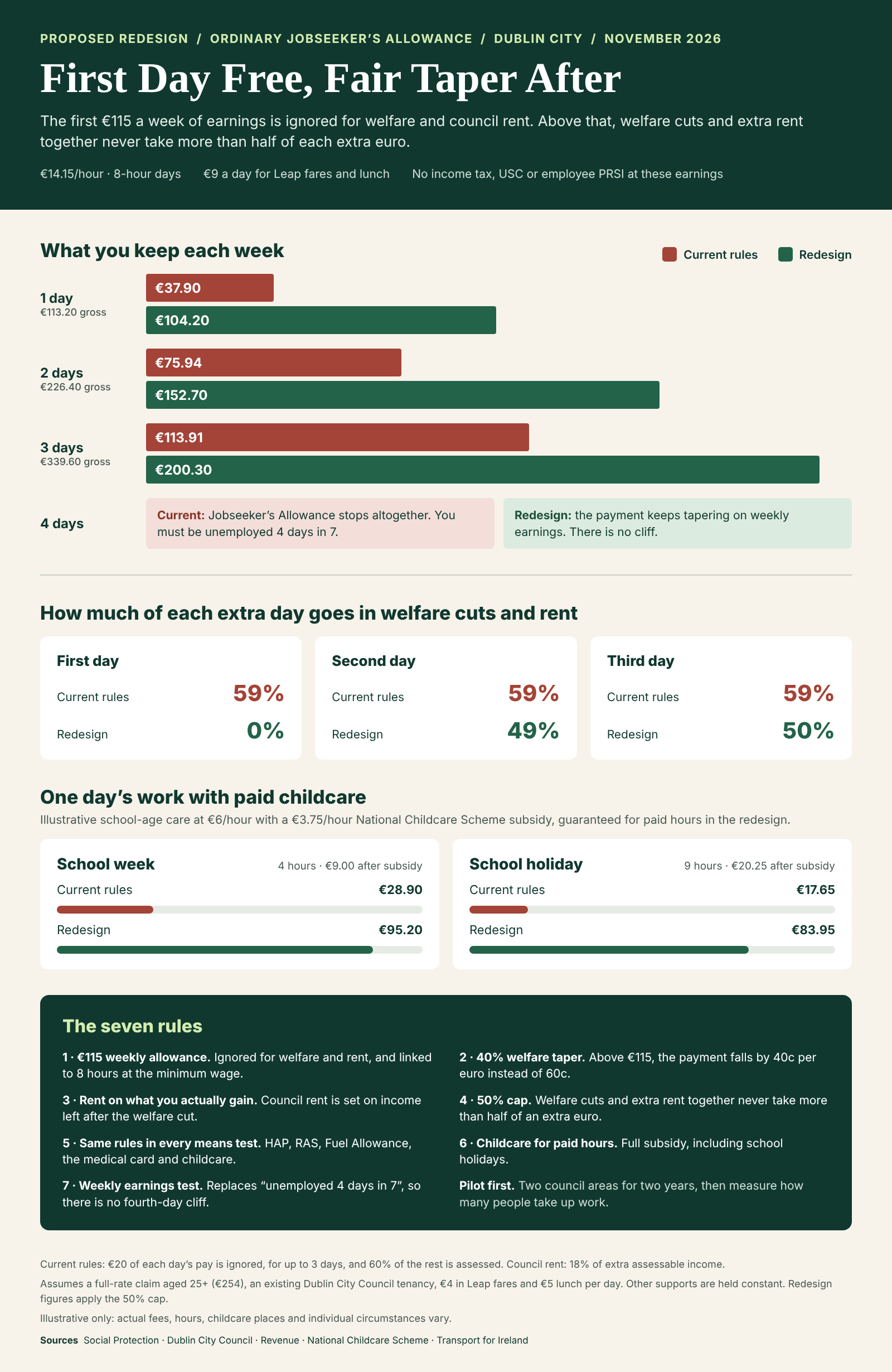
Tap the graphic to open it full size and save or share it.
Fair questions
Isn’t this unfair to low-paid workers who aren’t on welfare?
The plan should go alongside a higher USC exemption threshold, so that people already in low-paid work gain too. The aim is that every extra hour pays, for everyone.
What does it cost?
For someone who already works one day a week, the State gives up about €56 a week in welfare savings and the council gives up about €20 a week in rent. The return comes from people who aren’t working today and take up a day’s work. That is why we propose a pilot first.
Won’t employers just split jobs into one-day shifts?
Because the allowance is weekly, it doesn’t reward one-day jobs in particular. The pilot would also track how often claimants are hired for exactly one day, and the €115 level would be reviewed if that pattern grows.
How would it be introduced?
Through a two-year pilot in two council areas, measuring how many people take up work and stay in it, before any national rollout.